Whether you are building your first LED blinker on a breadboard or designing a multi-layer PCB, capacitors will appear in virtually every circuit you touch. They are the second most common passive component after resistors, and understanding them deeply will make you a significantly better electronics designer.
This guide covers everything from the underlying physics to practical selection advice, with real formulas, comparison tables, and hands-on tips you can apply to your next project.
What Is a Capacitor?
A capacitor is a two-terminal component that stores energy in an electric field between two conductive plates separated by an insulating material called a dielectric. When voltage is applied, charge accumulates on the plates. When the voltage source is removed, the capacitor can release that stored energy back into the circuit.
The Water Tank Analogy
Think of a capacitor as a small water tank connected to a pipe:
- Voltage is the water pressure.
- Current is the flow of water.
- Capacitance is the size of the tank.
When you turn on the tap (apply voltage), water fills the tank. A large tank (high capacitance) takes more water (charge) to fill to the same pressure (voltage). When you turn off the tap but open a drain valve, the tank releases its stored water into the circuit.
This is exactly why capacitors are used for power supply smoothing — they fill up during voltage peaks and release energy during dips, keeping the output stable.
The fundamental relationship is:
Q = C x V
Where Q is charge in coulombs, C is capacitance in farads, and V is voltage.
Key Specifications
Before choosing a capacitor, you need to understand its critical parameters.
Capacitance
Capacitance is measured in farads (F), but one farad is enormous. In practice, you will work with:
| Unit | Symbol | Value | Typical Use |
|---|---|---|---|
| Microfarad | uF | 10^-6 F | Power filtering, bulk storage |
| Nanofarad | nF | 10^-9 F | Decoupling, timing |
| Picofarad | pF | 10^-12 F | RF circuits, oscillators |
Voltage Rating
The maximum voltage a capacitor can safely handle. Always derate by at least 20%. If your circuit runs at 12V, use a capacitor rated for 16V or 25V minimum. Operating a capacitor near its rated voltage dramatically shortens its lifespan, especially for electrolytics.
ESR (Equivalent Series Resistance)
Every real capacitor has some internal resistance. Low ESR matters in power supply filtering and high-frequency decoupling. Tantalum and ceramic capacitors generally have lower ESR than aluminum electrolytics. High ESR causes power loss as heat and reduces filtering effectiveness.
Temperature Coefficient
Describes how capacitance changes with temperature. This is critical for precision circuits like oscillators and filters. Ceramic capacitors vary widely here — from the ultra-stable C0G/NP0 to the wildly varying Y5V.
Tolerance
How much the actual capacitance can deviate from the marked value. Ceramic capacitors range from +/-1% (C0G) to +80%/-20% (Y5V). Electrolytics are typically +/-20%.
Reading Capacitor Values
3-Digit Code (Ceramic and Film Capacitors)
The most common marking system uses three digits: the first two are significant figures, and the third is a multiplier (number of zeros to add). The result is in picofarads.
| Marking | Calculation | Value |
|---|---|---|
| 104 | 10 x 10^4 pF | 100,000 pF = 100 nF |
| 103 | 10 x 10^3 pF | 10,000 pF = 10 nF |
| 222 | 22 x 10^2 pF | 2,200 pF = 2.2 nF |
| 471 | 47 x 10^1 pF | 470 pF |
| 100 | 10 x 10^0 pF | 10 pF |
| 101 | 10 x 10^1 pF | 100 pF |
Memory trick: 104 is the most common capacitor you will use (100 nF for decoupling). Memorize it, and the rest of the system falls into place.
Electrolytic Capacitor Markings
Electrolytic capacitors print their values directly: 100uF 25V, 470uF 16V, etc. The negative terminal is marked with a stripe of minus signs on the body. On the PCB, the longer lead is positive.
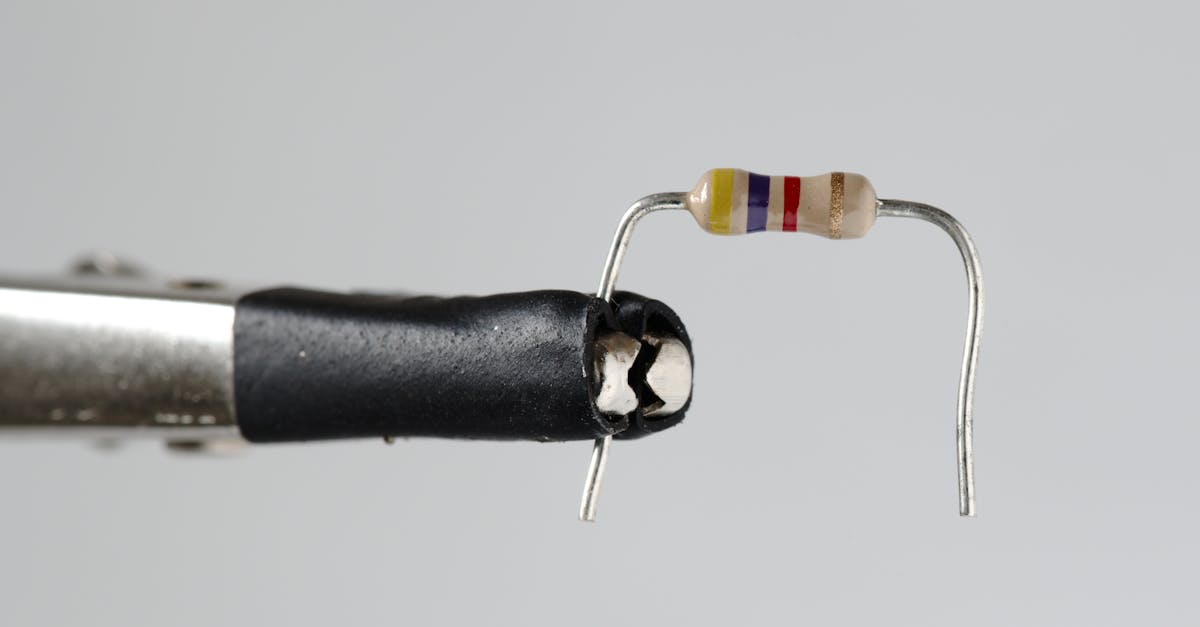
Old Ceramic Color Codes
Older ceramic disc capacitors used a color band system similar to resistors. While rare in modern components, you may encounter them in vintage equipment. The colors follow the standard resistor code (black=0, brown=1, red=2, etc.) applied to picofarad values.
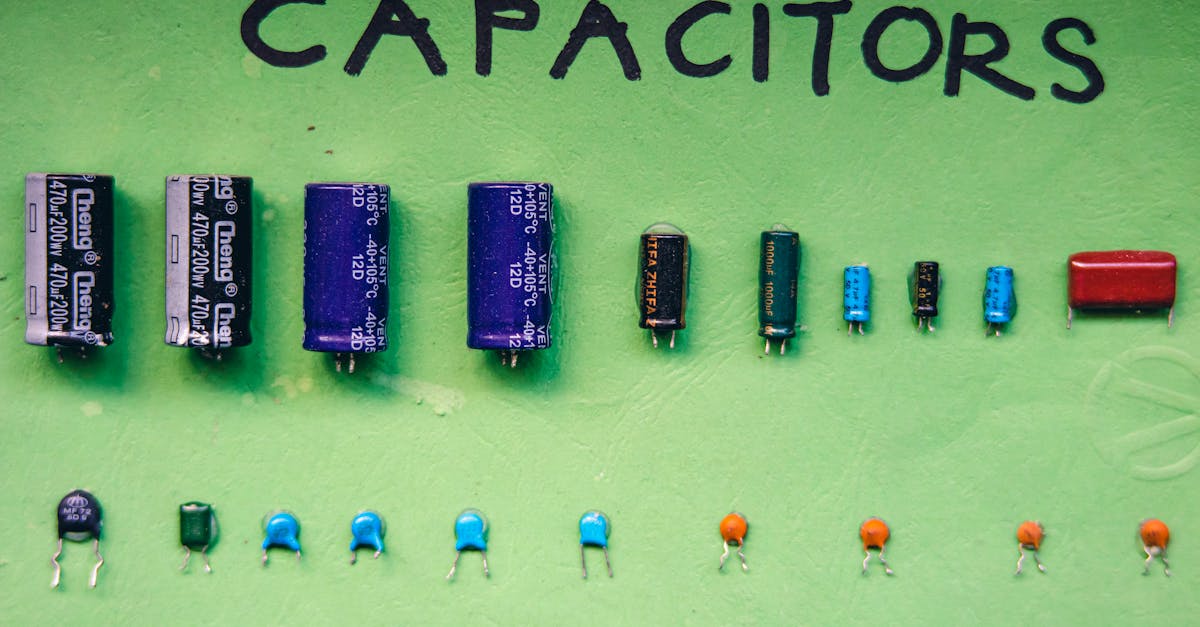
Types of Capacitors
Ceramic (MLCC — Multi-Layer Ceramic Capacitor)
The workhorse of modern electronics. Tiny, cheap, non-polarized, and available from 1 pF to 100 uF.
Dielectric classes matter enormously:
| Class | Capacitance Range | Temp Stability | Voltage Dependence | Best For |
|---|---|---|---|---|
| C0G / NP0 | 1 pF - 10 nF | Excellent (+/-30 ppm/C) | None | Oscillators, filters, timing |
| X7R | 100 pF - 10 uF | Good (+/-15%) | Moderate (loses ~30% at rated V) | General decoupling, bypass |
| X5R | 100 pF - 100 uF | Acceptable (+/-15%) | Significant | Bulk decoupling |
| Y5V | 10 nF - 100 uF | Poor (+22%/-82%) | Severe (loses ~80% at rated V) | Non-critical bulk, avoid if possible |
Important: An X7R capacitor marked 10 uF at 16V may only provide 7 uF when 10V is actually applied across it, due to DC bias derating. A Y5V can lose 80% or more. Always check the manufacturer's DC bias curves for your operating voltage.
Electrolytic (Aluminum)
Large cylindrical cans packed with capacitance. The go-to choice for bulk energy storage and power supply filtering.
- Capacitance range: 0.1 uF to 10,000+ uF
- Voltage range: 6.3V to 450V+
- Polarized: Yes. Reversing polarity can cause catastrophic failure (venting, explosion)
- ESR: Relatively high compared to ceramic or tantalum
- Lifespan: Limited by electrolyte evaporation; rated in hours at max temperature (e.g., 2000h at 105C)
Rule of thumb: Use electrolytics for bulk filtering (100 uF - 1000 uF) and always place a small ceramic (100 nF) in parallel nearby for high-frequency noise that the electrolytic cannot handle.
Tantalum
Compact, stable, and with very low ESR compared to aluminum electrolytics.
- Capacitance range: 0.1 uF to 1000 uF
- Voltage range: 2.5V to 50V
- Polarized: Yes, and extremely sensitive to reverse polarity
- Cost: 3-10x more expensive than equivalent electrolytics
Warning: Tantalum capacitors can catch fire or explode if subjected to reverse polarity, excessive voltage, or high inrush current. Always derate by at least 50% on voltage (use a 10V tantalum for a 5V rail). Despite the risk, they are excellent for low-noise power supplies in audio and precision analog circuits where low ESR and stability are worth the cost.
Film (Polyester / Polypropylene)
Film capacitors use a thin plastic film as the dielectric. They are non-polarized, have excellent stability, very low ESR, and self-healing properties (small dielectric breakdowns clear themselves).
| Film Type | Key Properties | Best For |
|---|---|---|
| Polyester (Mylar) | Cheap, compact, moderate stability | General purpose, timing, coupling |
| Polypropylene | Very low loss, tight tolerance | Audio crossovers, resonant circuits, SMPS snubbers |
Film capacitors are larger than ceramics for the same capacitance but are the preferred choice for audio signal paths, timing circuits, and applications where capacitance stability over voltage and temperature matters.
Supercapacitors (EDLC)
A different beast entirely. Supercapacitors bridge the gap between capacitors and batteries.
- Capacitance range: 0.1 F to 3000+ F (yes, farads, not microfarads)
- Voltage range: 2.5V to 2.7V per cell (series stacking for higher voltages)
- ESR: Higher than regular capacitors
- Leakage: Significant self-discharge over hours/days
Use cases: RTC backup power, energy harvesting buffer, peak current assist for motors, bridge power during supply switching. They are not a battery replacement for long-term storage but excel at delivering bursts of energy and surviving millions of charge cycles.
Capacitor Type Comparison Table
| Feature | Ceramic (MLCC) | Electrolytic | Tantalum | Film | Supercapacitor |
|---|---|---|---|---|---|
| Capacitance | 1 pF - 100 uF | 0.1 uF - 10,000 uF | 0.1 uF - 1000 uF | 100 pF - 10 uF | 0.1 F - 3000 F |
| Max Voltage | 6.3V - 1kV+ | 6.3V - 450V+ | 2.5V - 50V | 50V - 2kV+ | 2.5V - 2.7V/cell |
| Polarized | No | Yes | Yes | No | Yes (usually) |
| ESR | Very low | High | Low | Very low | Moderate |
| Size | Tiny | Large | Small | Medium-Large | Large |
| Cost | Very low | Low | High | Moderate | Moderate-High |
| Lifespan | Excellent | Limited (electrolyte dries) | Good | Excellent | Excellent (cycles) |
| Best For | Decoupling, RF, timing | Bulk power filtering | Low-noise power, compact | Audio, timing, snubbers | Energy storage, backup |
Common Uses in Electronics
1. Decoupling and Bypass (100 nF Ceramic Near Every IC)
This is the single most important use of capacitors in digital electronics. Every IC draws brief, sharp current spikes when its internal transistors switch. These spikes cause voltage dips on the power rail that can cause glitches in other chips.
A 100 nF ceramic capacitor placed as close as physically possible to each IC's VCC and GND pins acts as a tiny local energy reservoir. It supplies the instantaneous current the IC needs, preventing the voltage from dipping.
Why 100 nF? It provides effective bypassing from roughly 1 MHz to 100+ MHz, which covers the switching noise of most digital ICs. For high-speed designs, add a smaller capacitor (10 nF or 1 nF) in parallel for higher-frequency coverage.
Placement matters: The capacitor must be within a few millimeters of the IC's power pins, with short, wide traces. A 100 nF cap placed 5 cm away on long, thin traces provides almost no benefit.
2. Power Supply Filtering
A typical power supply output filter uses a large electrolytic (100 uF - 1000 uF) for bulk energy storage alongside a small ceramic (100 nF - 1 uF) for high-frequency ripple rejection. The electrolytic handles low-frequency ripple while the ceramic handles the fast transients that the electrolytic's high ESR cannot absorb.
3. Timing Circuits (RC Time Constant)
A resistor and capacitor together create a time delay:
t = R x C
Where t is the time constant in seconds, R is resistance in ohms, and C is capacitance in farads. After one time constant, the capacitor charges to approximately 63.2% of the applied voltage.
Example: A 10 kOhm resistor with a 100 uF capacitor:
t = 10,000 x 0.0001 = 1 second
The capacitor reaches ~63% of VCC after 1 second, ~86% after 2 seconds, ~95% after 3 seconds, and ~99% after 5 time constants (5 seconds).
Use C0G ceramics or film capacitors for timing circuits. X7R and electrolytic capacitors have too much capacitance drift with temperature, voltage, and age.
4. AC Coupling (DC Blocking)
A capacitor in series with a signal path blocks DC while passing AC. This is essential when connecting stages with different DC bias points (such as between amplifier stages or between a microphone and an amplifier input).
The cutoff frequency is:
f = 1 / (2 x pi x R x C)
Choose the capacitor so this frequency is well below the lowest signal frequency you want to pass.
5. Motor Noise Suppression
DC motors generate electrical noise from brush commutation. A 100 nF ceramic capacitor across the motor terminals (and optionally from each terminal to the motor case) suppresses this noise and prevents it from interfering with nearby electronics, such as a microcontroller reading sensors.
Capacitors in Series and Parallel
Parallel (Capacitances Add)
Connecting capacitors in parallel is straightforward — total capacitance is the sum:
C_total = C1 + C2 + C3 + ...
Example: 100 uF + 100 uF in parallel = 200 uF. The voltage rating remains the same as the lowest-rated capacitor.
This is how you increase total capacitance or combine different types (electrolytic + ceramic) for broadband filtering.
Series (Reciprocals Add)
Connecting capacitors in series reduces total capacitance:
1/C_total = 1/C1 + 1/C2 + 1/C3 + ...
For two capacitors: C_total = (C1 x C2) / (C1 + C2)
Example: Two 100 uF capacitors in series = (100 x 100) / (100 + 100) = 50 uF. However, the voltage rating effectively doubles (each capacitor sees half the total voltage).
Series connection is mainly used to increase voltage rating when a single capacitor with sufficient voltage rating is unavailable, or in specific filter topologies.
How to Choose the Right Capacitor
Follow this decision process:
Step 1: What is the function?
- Decoupling/bypass: Start with 100 nF ceramic (X7R or better)
- Bulk power filtering: Aluminum electrolytic + ceramic in parallel
- Timing/oscillator: C0G ceramic or polypropylene film
- Audio signal path: Film (polypropylene preferred)
- Energy storage/backup: Supercapacitor
Step 2: What capacitance do you need?
- Calculate based on your circuit requirements (RC time constant, filter cutoff, ripple spec)
- For decoupling, 100 nF is the default starting point
Step 3: What voltage rating?
- Take your maximum operating voltage and multiply by 1.5 to 2x
- For tantalum, derate by at least 50% (use 10V rated for 5V rail)
Step 4: Does ESR matter?
- High-current power supply output: Yes, use low-ESR electrolytic or tantalum
- Simple decoupling: Ceramic is already low ESR
- Audio: Film capacitors for lowest distortion
Step 5: Does stability matter?
- Timing or filter circuit: Use C0G ceramic or film
- General bypass: X7R is fine
Step 6: Physical size constraints?
- SMD ceramic for minimal space
- Through-hole electrolytic if board space allows
- Tantalum as a compact alternative to electrolytic
Measuring Capacitance with a Multimeter
Many modern multimeters include a capacitance measurement mode. A meter like the UNI-T UT890D+ can measure capacitance directly:
- Set the dial to the capacitance mode (often marked with the capacitor symbol or "F").
- Discharge the capacitor first by shorting its leads together briefly. A charged capacitor can damage the meter or give false readings.
- Insert the capacitor into the dedicated capacitance measurement slots (if available) or use the probe leads.
- Read the value. For small ceramics (pF to nF range), the meter may not have sufficient resolution. Most affordable multimeters are accurate from about 1 nF upward.
Tip: If you are testing electrolytic capacitors, also check ESR if your meter supports it. A capacitor can show correct capacitance but have dangerously high ESR due to age, indicating it needs replacement.
Common Mistakes to Avoid
1. Reversed Polarity on Electrolytic or Tantalum Capacitors
This is the most dangerous beginner mistake. Electrolytic capacitors will vent, leak, or explode. Tantalum capacitors can catch fire — they contain a flammable fuel (manganese dioxide) that ignites on internal short circuits. Always double-check polarity before powering on.
2. Insufficient Voltage Derating
Running a 16V-rated electrolytic at 15V is asking for premature failure. Running a 6.3V-rated tantalum at 5V is asking for a fire. Always derate: 20% minimum for electrolytics, 50% for tantalum.
3. Ignoring ESR in Switching Power Supplies
A cheap electrolytic with high ESR in a switching regulator output causes excessive ripple and heat. Use capacitors specifically rated for low ESR or switch to solid polymer electrolytics.
4. Using Y5V Where Stability Matters
Y5V capacitors can lose over 80% of their marked capacitance at operating voltage and temperature extremes. That "10 uF" capacitor might only provide 2 uF in your actual circuit. Use X7R minimum for anything functional.
5. Placing Decoupling Caps Too Far from the IC
A decoupling capacitor connected through 3 cm of trace is not decoupling anything at high frequencies. The trace inductance defeats the purpose. Place the cap as close to the IC power pins as physically possible, ideally on the same side of the PCB.
6. Forgetting DC Bias Derating for Ceramics
A 10 uF X7R capacitor rated at 10V might only give you 5-6 uF when you actually apply 5V across it. Check the manufacturer's DC bias curves. You may need to use a higher-rated capacitor or a larger physical size to get your required capacitance at operating voltage.
Practical Example: Adding Decoupling Caps to an ESP32 Breadboard Project
The ESP32 is a power-hungry WiFi/Bluetooth microcontroller with sharp current spikes during radio transmission (up to 500 mA peaks). Poor decoupling causes brownouts, random resets, and WiFi instability.
Here is how to properly decouple an ESP32 DevKit on a breadboard:
-
Bulk capacitor on the power rail: Place a 100 uF electrolytic across the main 3.3V and GND rails of your breadboard, near where power enters. This provides bulk energy storage for WiFi transmission bursts.
-
Local decoupling: Place a 100 nF (104) ceramic capacitor directly across the 3.3V and GND pins of the ESP32 module, as close to the pins as possible. On a breadboard, this means in the holes immediately adjacent to the power pins.
-
Additional high-frequency bypass: Add a 10 nF (103) ceramic in parallel with the 100 nF for better high-frequency noise rejection.
-
If using sensors on the same breadboard: Add another 10 uF electrolytic near the sensor's power pins, plus a 100 nF ceramic. This isolates sensor power from the ESP32's noisy supply.
Result: Fewer random resets, more stable WiFi connections, and cleaner ADC readings from analog sensors. This takes two minutes and a handful of inexpensive capacitors, but dramatically improves reliability.
Storage and Handling Tips
- Electrolytic capacitors degrade with age, even when unused. The electrolyte can dry out over years. If using electrolytics from old stock, reform them by slowly bringing up voltage through a current-limiting resistor before full-power use.
- Store capacitors in anti-static bags in a cool, dry environment. Moisture and high temperature accelerate degradation.
- Large electrolytic capacitors can hold dangerous charge long after power is removed. Always discharge before handling, especially in power supply circuits. A 400V capacitor from a mains power supply can be lethal.
- Keep ceramic SMD capacitors away from mechanical stress. They are brittle and can crack during board flexing, causing either open circuits or dangerous short circuits.
- Label your component storage. A 100 nF ceramic and a 10 nF ceramic look identical. Organize by value, and when in doubt, measure with your multimeter before use.
Wrapping Up
Capacitors are deceptively simple components with surprisingly deep behavior. The difference between a circuit that works reliably and one that is plagued by mysterious resets, noise, and instability often comes down to proper capacitor selection and placement.
Key takeaways:
- Always place 100 nF ceramic decoupling caps near every IC
- Derate voltage ratings (20% for electrolytics, 50% for tantalum)
- Match the capacitor type to the application: C0G for timing, X7R for decoupling, electrolytic for bulk storage, film for audio
- Watch out for DC bias derating on ceramic capacitors
- Never reverse polarity on electrolytic or tantalum capacitors
- Combine electrolytic (bulk) and ceramic (high-frequency) in parallel for effective power filtering
Understanding these principles will save you countless hours of debugging and help you build more reliable projects from the start.